
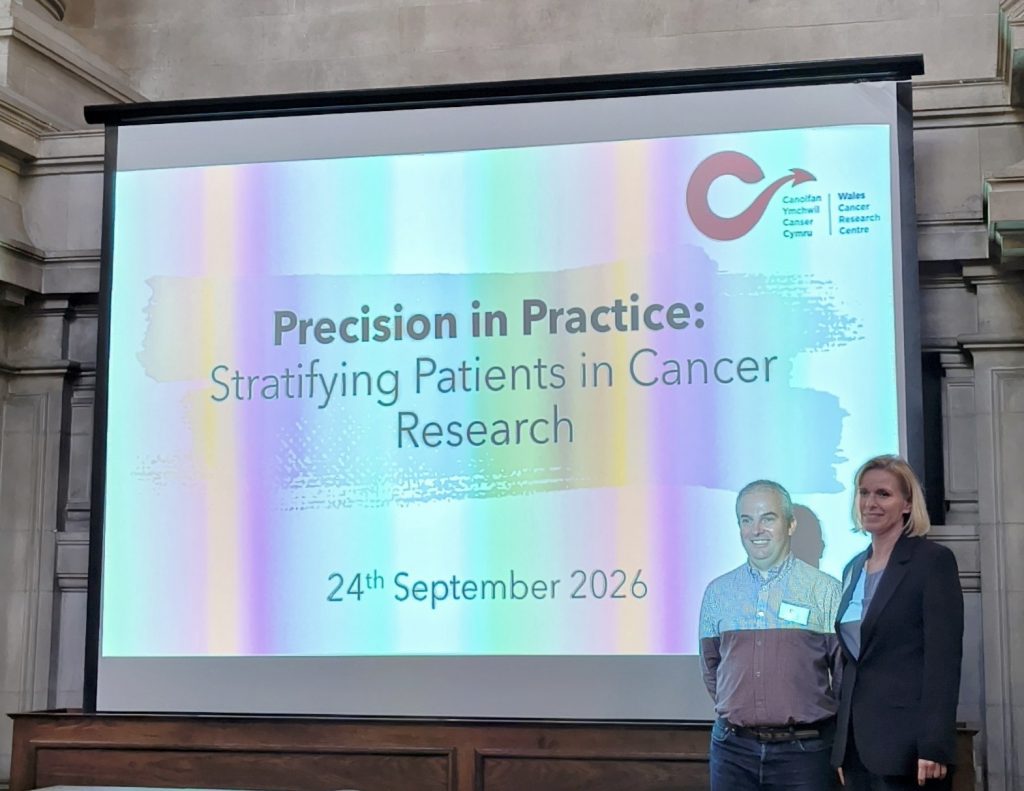
On 24th September, WCRC welcomed ~40 attendees from across Wales for Precision in Practice: Stratifying Patients in Cancer Research.
Chaired by Dr Magda Meissner (Velindre Cancer Centre & Cardiff University) and Dr Jason Webber (Swansea University), the event gave attendees the opportunity to learn how cancer researchers at all career stages, in labs and hospitals throughout Wales are using different methods, technologies, and resources to advance the development of personalised and precision medicine approaches to diagnostics.
The day delivered inspiring talks as well as plenty of networking and discussion time, with delegates exploring how they may develop collaborations in future.
With talks on topics covering a range of diagnostic tools and techniques for stratifying patients in cancer research, grant funding, and how we can use data to promote early detection, it was a packed agenda that sparked lots of discussion and knowledge sharing.
Feeding back on the day, 100% of respondents said (where applicable) they met someone at the event who they could collaborate with in the future. Furthermore, highlighting the importance of public and patient involvement (PPI) in research, one attendee noted that “discussions included PPI input relating to successful research which focussed on patient outcomes and the importance of public awareness of research”.
The WCRC team would like to extend our thanks to everyone who attended the meeting, and in particular, the speakers who presented their work:
Dr Magda Meissner (Velindre Cancer Centre & Cardiff University) – Integrating ctDNA into cancer diagnostic pathways
Dr Jason Webber (Swansea University) – Utilising extracellular vesicles for prostate cancer detection and stratification of disease
Dr Lee Campbell (Cancer Research Wales) – Grants and What Makes a Successful Application
Dr Isobella Honeyborne (Cardiff University) – From Tuberculosis to Tumour Biology
Dr Mohamad Kamarizan (Swansea University) – Serum Raman spectroscopy to personalise management of rectal polyps and cancer
Prof Andrew Beggs (University of Birmingham) – Nanopore sequencing of ctDNA as a cheap, scalable method in the NHS
Prof Duncan Baird (Cardiff University) – Telomere length and genome instability in the clinic
Dr Arron Lacey (Swansea University) – Using Welsh Linked Population Cancer Data for Early Detection